Faculty Development Program on Business Analytics and Tools

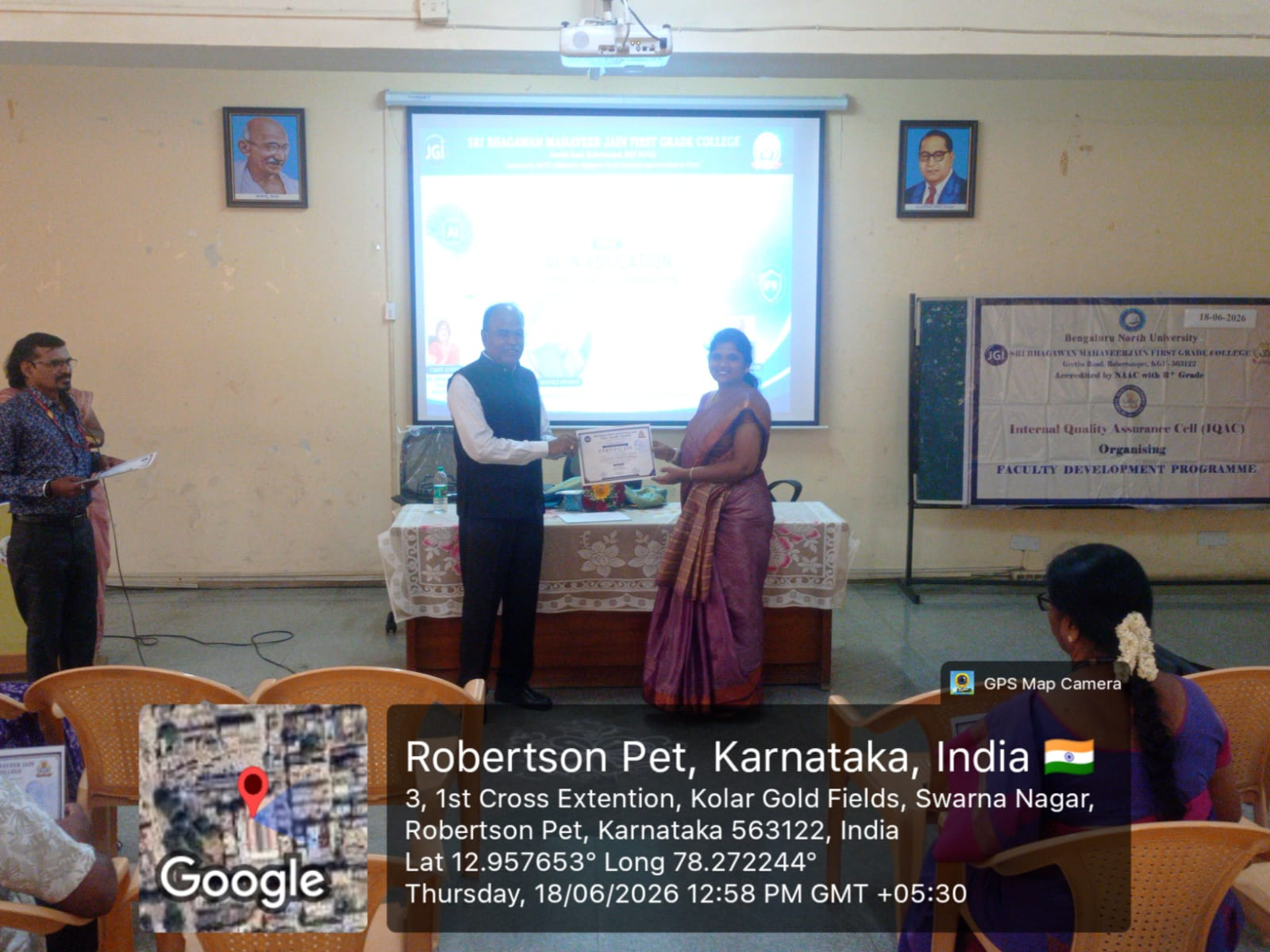
Third day  of Faculty Development Program was successfully conducted on 31st July 2024, Dr. Rekha Sethi Principal, IQAC Co-ordinator Dr. L Jayapandian, Heads of all the departments were present. The Faculty Development Program received an overwhelming response with 65 participants.

Date: 31st July 2024,

Venue: Auditorium

Resource Person:

Ms. Sandhya V

Asst. Professor

Department of Commerce

SBMJFGC, KGF

The Faculty Development Program on Business Analytics and Tools focused on understanding the role of analytics in business decision-making. The session covered key concepts of business analytics, including data collection, processing, and interpretation, to extract meaningful insights for organizations.

Participants were introduced to various analytical tools and techniques used for data visualization, predictive analysis, and reporting. The program highlighted how these tools enable data-driven strategies, improve efficiency, and support effective decision-making in a competitive business environment.

Department of Computer Science BCA Students Presented and published paper in Kristu Jayanthi College Bengaluru

The Department of Computer Science BCA Students Presented and published paper in Kristu Jayanthi College Bengaluru

Title of the Conference : Vikas Bharath 2047:Neo-Human Intelligence & Next Gen technologies

Date: 11-02-2026

Faculty In-charge : Mr. Dileep D , Assistant professor- SBMJFGC-KGF

Total Number Of Students Attended:07

outcome of the Conference:

  1. Human–AI Collaboration
    Development of Neo-Human Intelligence where humans and Artificial Intelligence work together to improve productivity and decision-making.
  2. Advanced Digital Infrastructure
    Strong nationwide digital connectivity through initiatives like Digital India to support innovation and smart services.
  3. Smart Governance
    Use of AI, blockchain, and data analytics for transparent, efficient, and corruption-free government systems.
  4. Next-Generation Education
    Integration of AI, robotics, and skill-based learning in schools and universities to prepare youth for future careers.
  5. Healthcare Transformation
    AI-based diagnostics, telemedicine, and precision medicine to improve healthcare access across rural and urban India.
  6. Innovation & Startup Growth
    Promotion of startups and research under programs like Startup India to build global technology leaders.
  7. Smart Cities & Sustainable Development
    Development of smart cities using IoT, renewable energy, and green technologies for a sustainable future.
  8. Cybersecurity Strengthening
    Advanced cyber defense systems to protect national data and digital infrastructure.
  9. Economic Growth through Emerging Technologies
    Expansion in sectors like AI, quantum computing, space tech, and biotechnology to make India a global technology hub.
  10. Inclusive Development
    Technology-driven growth ensuring opportunities for all sections of society, including rural communities and women empowerment.

Department of Computer Science faculties Presented and Published paper in International Conference

The Department of Computer Science faculties Mr. Siddarama S Head, Department of computer science and Mr. Teekshith Kumar M ,Assistant Professor presented and Published paper in 7th International Conference

Place : Vijaya College ,Jayanagar 11th main, 4th Block Bengaluru

on : 24th January 2026

Theme Of Conference : The Relevance of Vedic Science in the Modern Artificial Intelligence world

Title of the paper : Artificial Intelligence in Health, Culture and Medicine With Vedic Science

Mr. Teekshith Kumar received Best Paper and best Presentation Award

ISBN Number : 9-788199-795525

Outcome of the Conference:

  1. Ethical AI Framework Development
    Principles from Vedic texts such as the Bhagavad Gita promote dharma (righteous conduct), helping design AI systems aligned with moral responsibility and human welfare.
  2. Holistic Problem-Solving Models
    Vedic philosophy emphasizes interconnectedness (Vasudhaiva Kutumbakam concept), encouraging AI systems that consider social, environmental, and human impact rather than isolated optimization.
  3. Knowledge Representation and Logic
    Ancient logical systems from Nyaya Sutras contribute to structured reasoning approaches similar to rule-based AI and symbolic logic models.
  4. Consciousness Studies and Cognitive AI
    Insights from Upanishads about mind and consciousness inspire advanced research in Artificial General Intelligence (AGI) and cognitive computing.
  5. Algorithmic Thinking Roots
    Structured mathematical reasoning found in Vedic mathematics supports optimization algorithms, rapid calculations, and computational efficiency in AI systems.
  6. Natural Language Processing (NLP) Advancement
    The grammatical precision of Sanskrit, formalized by Panini in the Ashtadhyayi, provides a rule-based linguistic structure useful for computational linguistics and NLP design.
  7. Human-Centered AI Development
    Vedic emphasis on balance between intellect and ethics encourages development of AI technologies that prioritize human well-being over pure automation.
  8. Sustainable Technological Innovation
    Vedic ecological perspectives promote sustainable AI infrastructure and responsible data center management to reduce environmental impact.
  9. Interdisciplinary Research Expansion
    Integrating Vedic philosophy with AI fosters collaboration between computer science, psychology, philosophy, and cognitive neuroscience.
  10. Cultural Preservation through AI
    AI technologies can digitize, analyze, and preserve Vedic manuscripts, ensuring long-term cultural continuity and scholarly accessibility.

Department of Computer Science Faculty’s Invited as a Resource person

The Department of Computer Science Faculty’s Invited as a Resource Person For SDP [Student Development Program ] at Nanda Gokula College PG Center- Tekal Road Kolar Karnataka.

  1. Mr. Siddarama S ,Associate Professor, Head, Department of Computer Science, SBMFGC-KGF
  2. Mr. Teekshith Kumar M , Assistant Professor, Department of Computer Science, SBMFGC-KGF

College Name: Nanda Gokula College of PG Center (MBA/M.Com)

Date: 09-01-2026

Title: 1. Cyber Crime And Security

2. Artificial Intelligence in Management and E-commerce

Out Come of the Student Development Program:

  1. Understand the fundamentals of cyber crime, cyber security, and artificial intelligence in the digital economy.
  2. Gain awareness of cyber threats, online frauds, and AI-enabled attacks affecting individuals and organizations.
  3. Learn security principles and safe digital practices for personal, academic, and professional environments.
  4. Understand the role of AI in enhancing cyber security and threat detection systems.
  5. Develop knowledge of data protection, privacy, and ethical use of digital technologies.
  6. Gain insight into AI-driven decision making in management and e-commerce platforms.
  7. Understand cyber laws, IT regulations, and compliance requirements relevant to digital business.
  8. Learn how AI improves customer experience, personalization, and online marketing strategies.
  9. Develop skills to identify cyber risks in e-commerce and online transactions.
  10. Understand the use of AI in fraud detection, risk management, and secure payment systems.
  11. Gain exposure to automation, analytics, and intelligent systems used in modern organizations.
  12. Learn best practices for secure online business operations and digital transactions.
  13. Develop critical thinking and problem-solving skills in cyber and AI-based scenarios.
  14. Build awareness of emerging careers in cyber security, AI, analytics, and digital management.
  15. Foster ethical responsibility, digital citizenship, and readiness for the digital workforce.

Department of Computer Science Faculties and students Presented and Published Paper in International Conference

The Department of Computer Science faculties and students Presented and Published Paper in International Conference at EAST point college, Bengaluru Karnataka

on : 12th December 2025 and 13th December 2025

At : Jayaram Auditorium, EAST Point College Avalahalli, Bengaluru

Faculty In-charge :

  1. Mr. Teekshith Kumar M, Assistant Professor Department of computer Science
  2. Mr. Dileep D, Assistant Professor Department of computer Science
  3. Ms.Rakshitha C, Assistant Professor Department of computer Science

Total Number of Students Attended : 22

Conference Theme :

Digital transformation ion Technology (NCDTTBC – 2025)

Publication Website : https://www.ijirae.com/volume-12-issue-12

ISSN Number :2349-2163

Sl.No Name Of Participant Designation Paper Title
1Mr. Siddarama S & Mr. Teekshith Kumar MAssociate Professor Neuro-Symbolic Artificial Integration
2Mr. Dileep D &
Ms. Sangeetha DS
Assistant Professor The role of IOT Transforming Health care in early detection
3Ms. Kalpana P &
Ms. Yeshaswini S
Assistant Professor / BCA Student Existing & Emerging AI Technology
4Ms.Rakshitha C & Ms.Shylu Assistant Professor IoT Enabling Technologies and Their Applications
5Mr. Ravi P &
Mr. Manoj
Assistant Professor / BCA Student AI in Business and Industrial Transformation
6 Ms. Devina
Margarate S &
Ms. Sameera Siddiqua
Assistant Professor / BCA Student The Future of AI and Data Driven Technologies
7 Ms. Sushma &
Ms. Harshitha KL
Assistant Professor / BCA Student Next Gen AI and data Innovation
8Mr. Navdeep M &
Mr. Franklin D
BCA Student Cyber Security and IOT devices in Industries
9Ms. Keerthana K BSc Student AI in daily Life
10Mr. Tharun P &
Mr.Hemanth K
BCA Student AI in Smart Cities and Urban Planning
11Mr. Bhargaw M &
Mr. Sathya P
BCA Student Ethical, Legal and Social Implications of AI
12Ms. Bhagya Lakshmi R &
Ms. Ayesha Aymen I
BCA Student Neuromorphic Computing and Brain Inspired AI
13Mr. Preetham M &
Mr. Joshua Gideon J
BCA StudentAI in health care and biotechnology
List of Students and Faculties Presented and Published papers